INDUSTRIAL AI: THE EDGE-CLOUD INFRASTRUCTURE SPLIT
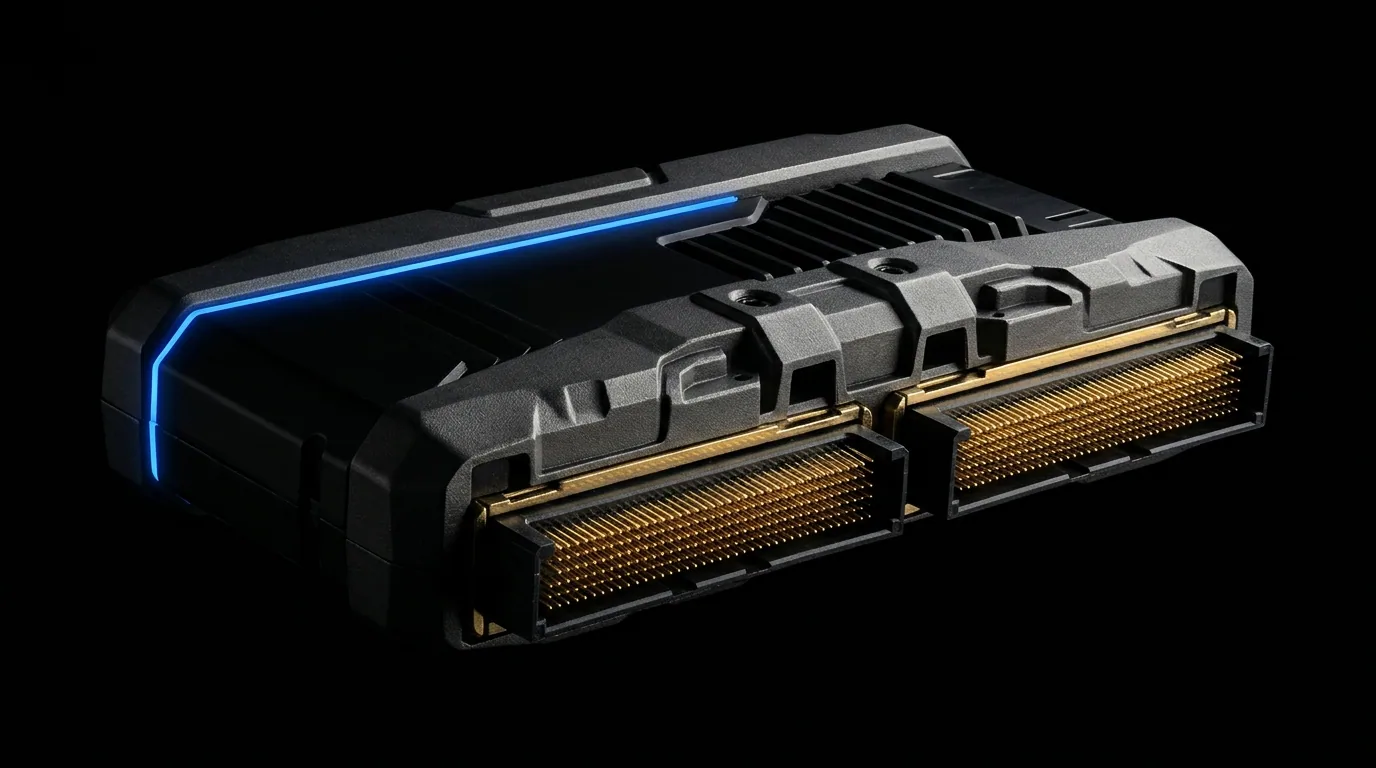
Manufacturing AI infrastructure operates on a fundamentally different model from other industries because the workload is split between real-time edge inference on the factory floor and offline training in data centers. A single automotive assembly plant runs 200-500 cameras across inspection stations, each processing 30-60 frames per second through defect detection models. The total GPU compute per plant is 50-200 edge GPU modules, typically NVIDIA Jetson AGX Orin (32-45 TOPS at 15-40W) or L40S for more demanding inspection tasks. The training infrastructure, usually 16-64 H100 GPUs in a centralized data center, retrains quality control models weekly as production lines introduce new parts and processes.
The global industrial AI GPU market is projected at $8-12 billion by 2027, driven by three converging trends: labor shortages in quality inspection, the need for zero-defect manufacturing in electronics and automotive, and the maturation of edge GPU hardware capable of running production models. Siemens and Bosch have deployed AI inspection across 1,000+ factories, each running 50-200 edge GPUs. The total GPU count in industrial deployments already exceeds gaming GPU deployments for AI, though the GPU value per unit is substantially lower at $1,000-$5,000 per edge module versus $25,000-$35,000 per H100 data center GPU.
| Manufacturing Workload | Hardware | Deployment | Units per Plant | Annual Cost per Plant |
|---|---|---|---|---|
| Visual QC (surface defects) | Jetson AGX Orin | Edge (line-side) | 50-200 cameras | $75K-$300K |
| Visual QC (high-precision) | L40S or RTX 6000 | Edge (station) | 10-50 modules | $100K-$500K |
| Predictive Maintenance | H100 80GB (cloud) | Training: 16-64 GPUs | 1 cluster per region | $500K-$2M |
| Digital Twin Simulation | B200 180GB | Cloud + edge | 8-16 GPUs per factory | $400K-$1M |
| Robotic Vision/Robotics | Jetson Orin NX | On-robot edge | 50-200 per plant | $50K-$200K |
VISUAL QUALITY CONTROL: DEFECT DETECTION AT 60 FRAMES PER SECOND
Visual quality inspection is the highest-volume industrial AI workload. A smartphone assembly line inspects 1,000-2,000 units per hour through 8-16 inspection stations, each running a CNN-based defect classifier on the product image. The model must detect scratches, gaps, misalignments, and foreign material down to 50-micron resolution. Running inference on a 5M-parameter EfficientNet or MobileNetV3 model through TensorRT FP16 achieves 2-5ms per inference on a Jetson AGX Orin, supporting real-time inspection at line speed. A single failed inspection saves $50-$500 in downstream rework costs for electronics manufacturers.
The training infrastructure for inspection models requires careful management of defect data. Manufacturing defects occur at rates of 0.1-2 percent, creating heavily imbalanced datasets. A typical training run uses 500,000 images with 5,000 defects, fine-tuning a pre-trained ResNet-50 on 8 H100 GPUs for 12-24 hours at a cost of $300-$700 per training run. The model is retrained weekly as the production line introduces new parts, meaning each plant's training workload consumes 100-150 H100 GPU-hours per month. For a multinational manufacturer with 50 plants, the centralized training infrastructure requires 100-200 H100 GPUs operating continuously.
PREDICTIVE MAINTENANCE: TIME-SERIES TRANSFORMERS ON SENSOR DATA
Predictive maintenance uses time-series transformer models on industrial IoT sensor data to predict equipment failures before they occur. A semiconductor fabrication plant has 10,000-50,000 sensors monitoring vibration, temperature, pressure, and power consumption across manufacturing equipment, each generating readings at 1-100 Hz. The daily data volume is 100-500GB per plant. Training a TimesNet or PatchTST model on 12 months of historical data across all sensors requires 16-32 H100 GPUs for 8-16 hours, costing $400-$1,600 per weekly training run.
The inference pipeline for predictive maintenance runs on the edge or near-edge. Each equipment group's model runs anomaly detection on sensor streams with sub-second latency. A single L40S GPU can process 1,000-2,000 sensor streams simultaneously through a 10M-parameter time-series model. For a fab with 50,000 sensors, the inference compute requires 25-50 L40S GPUs. The ROI is compelling: a single unplanned fab outage costs $500,000-$2,000,000 per hour in lost production, and predictive maintenance systems at TSMC and Samsung foundries have reduced unplanned downtime by 30-50 percent. The annual GPU infrastructure cost of $500,000-$2,000,000 per plant is recovered by preventing a single extended outage.
DIGITAL TWINS AND SIMULATION FOR MANUFACTURING OPTIMIZATION
Digital twin simulation is the fastest-growing GPU workload in manufacturing, driven by NVIDIA's Omniverse platform. A digital twin of an automotive production line models every robot arm, conveyor belt, and weld station in physically accurate simulation, enabling production engineers to test line reconfigurations without stopping physical production. Running a full factory digital twin requires 8-16 B200 GPUs for real-time ray-traced visualization and physics simulation, with each B200 handling approximately 50-100 simulated objects. BMW's digital twin of its Regensburg plant uses 64 B200 GPUs and has reduced line changeover times by 30 percent.
The training infrastructure for digital twin AI models is distinct from other manufacturing workloads. Reinforcement learning agents trained in simulation learn optimal production scheduling, robot coordination, and material flow policies. Each RL training run requires 10,000-50,000 simulated episodes across 64-256 GPU environments running in parallel. A single policy for robot arm coordination consumes 5,000-20,000 H100 GPU-hours to converge, costing $15,000-$60,000 per policy. BMW and Siemens invest $5-10 million annually in GPU compute for digital twin and RL training, achieving payback through 15-25 percent improvements in production line throughput.
EDGE VS CLOUD: BUILDING THE INDUSTRIAL GPU ARCHITECTURE
The optimal industrial GPU architecture follows a three-tier model. Tier 1 is on-robot or on-station edge inference using NVIDIA Jetson modules ($400-$2,000 per unit) for latency-critical tasks like defect detection and robotic vision, with inference under 10ms. Tier 2 is near-edge servers with L40S or RTX 6000 GPUs in factory server rooms for plant-wide workloads like predictive maintenance and multi-camera fusion. Tier 3 is centralized data center GPU clusters with H100 or H200 for model training and digital twin simulation. This tiered approach reduces total GPU cost by 35-50 percent compared to running all workloads on cloud GPUs.
The connectivity between tiers is critical. Tier 1 devices operate offline or on local networks with 50-100ms synchronization windows. Tier 2 devices aggregate edge results and communicate with Tier 3 over 1-10 Gbps WAN links during off-peak hours. Manufacturers should budget $3,000-$8,000 per plant per month for the Tier 2-3 GPU compute and $500-$2,000 per plant per month for edge GPU amortization. ClusterBid supports this tiered model by sourcing edge GPU hardware through partner channels and data center GPUs through the competitive marketplace, enabling manufacturers to procure both tiers through a single platform.