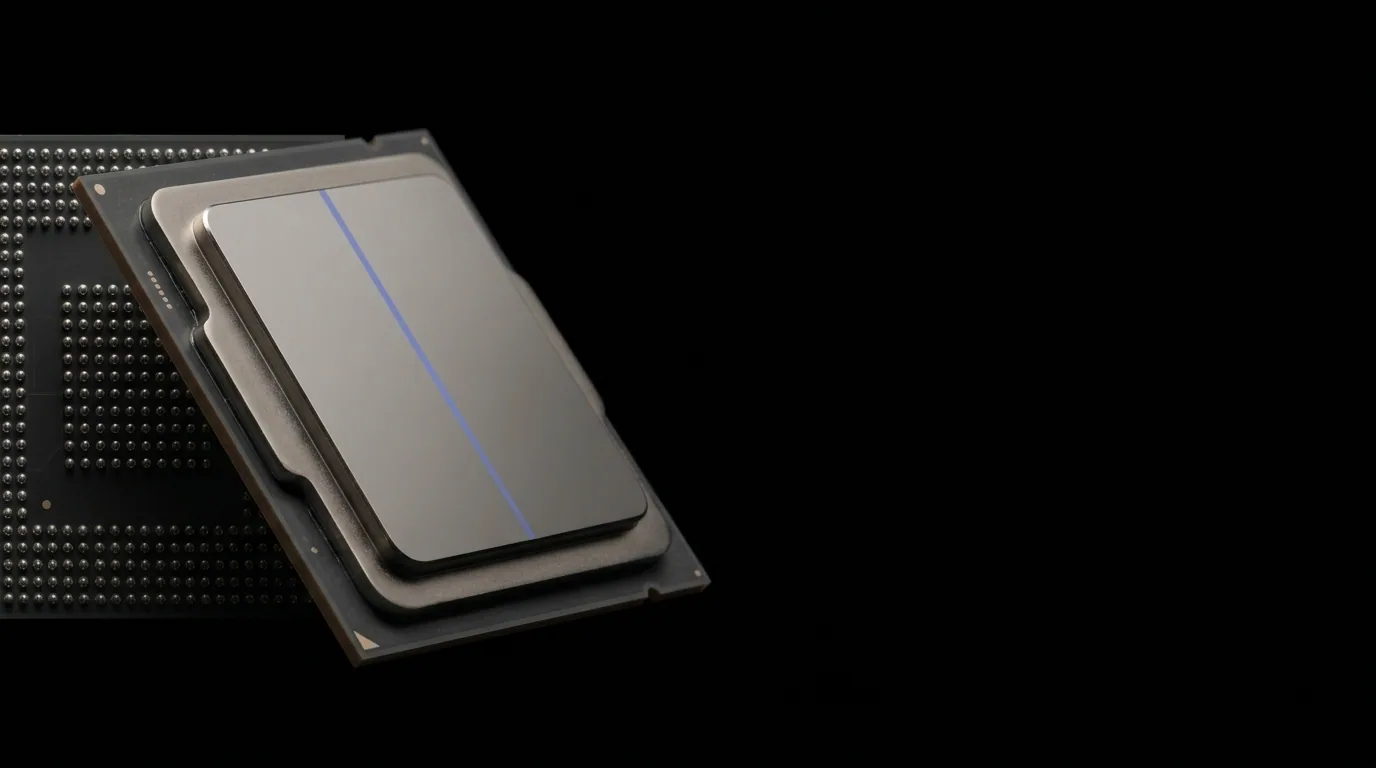
Intel Falcon Shores Architecture
Intel Falcon Shores represents a fundamental departure from the Max series (Ponte Vecchio). The architecture uses a tile-based design with chiplets fabricated on Intel 3 and 4 processes, connected through an advanced EMIB (Embedded Multi-Die Interconnect Bridge) fabric. Each Falcon Shores package integrates compute tiles, HBM3e memory stacks, and an I/O die in a single socket, targeting up to 288GB of HBM3e per package.
The compute tile introduces Intel's Xe Matrix Extension (XMX) engine for matrix math that supports FP64, FP32, TF32, FP16, BF16, FP8, and FP4 precisions. The key architectural claim is competitive FP8 matrix throughput against NVIDIA B200 at roughly 70 percent of the peak teraFLOPS, with higher announced FP64 throughput for scientific computing workloads. Memory bandwidth is projected at 6.5-7.0 TB/s per package, below the B300's 8.0 TB/s but competitive with B200.
NVIDIA Comparative Positioning
NVIDIA's B200 delivers 4.5 TFLOPS per GPU on FP8 with sparsity, while Falcon Shores targets approximately 3.2 TFLOPS on FP8 per package based on Intel disclosed specifications. The B300 at 8.0 TFLOPS FP8 with sparsity is in a separate performance tier altogether, targeting workloads that Falcon Shores is not designed to compete with. The realistic competitive frame is Falcon Shores vs B200, not against B300.
The critical NVIDIA advantage is NVLink 5 at 1.8 TB/s per GPU, which enables coherent memory domains across up to 576 GPUs. Intel has announced Xe Link as its multi-GPU interconnect but disclosed specifications suggest 800-900 GB/s per direction, comparable to NVLink 4 in the H100/H200 generation. For workloads requiring frequent all-reduce across many GPUs, the interconnect bandwidth difference of roughly 2x is material.
Benchmark Projections and Published Results
Intel has not published independent MLPerf results for Falcon Shores as of mid-2026. The company disclosed internal benchmarks on a 64-GPU Falcon Shores cluster running GPT-3 175B training at approximately 55 percent of the throughput of a 64-GPU H200 cluster in FP16/BF16 precision. On inference, Falcon Shores showed approximately 60 percent of H200 throughput on Llama-3 70B serving with batch size 32 in published Intel engineering test results.
The raw compute gap narrows significantly at lower precision. In FP8 inference with weight-only quantization, Falcon Shores reaches approximately 70 percent of H200 tokens-per-second throughput on Llama-3 8B and Mistral-based models. Intel's internal testing shows Falcon Shores achieving competitive throughput on INT8 quantized models, which may find a niche in inference deployments that can tolerate integer quantization.
| Metric | Falcon Shores | NVIDIA B200 | NVIDIA H200 |
|---|---|---|---|
| FP8 TFLOPS (peak) | ~3,200 | 4,536 | 1,979 |
| HBM3e Capacity | 288 GB | 192 GB | 141 GB |
| Memory Bandwidth | 6.5-7.0 TB/s | 8.0 TB/s | 4.8 TB/s |
| Interconnect BW | ~900 GB/s | 1.8 TB/s | 900 GB/s |
| MLPerf Training (GPT-3 175B) | ~55% of H200 | ~130% of H200 | Baseline |
| TDP | ~700W | 1,000W | 700W |
| Transistor Count | ~100B (est.) | 208B | 80B |
Software Ecosystem Readiness
The software situation is the defining risk for Falcon Shores adoption. Intel has invested heavily in SYCL and oneAPI as the programming model, but production AI teams overwhelmingly use CUDA and the NVIDIA stack. PyTorch and JAX support Falcon Shores through the Intel Extension for PyTorch (IPEX), which maps PyTorch operations to oneAPI kernels. In practice, this means major model architectures from Hugging Face require manual verification that each custom kernel has a oneAPI equivalent.
NVIDIA's advantage compounds with each software layer. cuBLAS, cuDNN, TensorRT-LLM, NCCL, and Triton Inference Server are production tested on every NVIDIA GPU generation. Intel has no equivalent of TensorRT-LLM for Falcon Shores. The Intel OpenVINO toolkit handles inference optimization but lags TensorRT-LLM on transformer-specific optimizations like continuous batching, paged attention, and FP4 quantization support. Teams considering Falcon Shores should budget 4 to 8 weeks of software validation before production deployment.
Supply, Availability, and Timing
Falcon Shores availability in 2026 has been limited to strategic cloud providers and select HPC installations. Intel's initial production allocation for H2 2026 is estimated at 200K-300K units, compared to NVIDIA's projected B200/B300 shipments exceeding 3 million units in the same period. This supply disparity means Falcon Shores will be available in meaningful quantities only through Intel-authorized cloud partners for at least the next 12 months.
The procurement calculus is inverted for Falcon Shores vs NVIDIA. NVIDIA GPUs are available through multiple channels including ClusterBid with competitive spot pricing and short lead times. Falcon Shores requires direct Intel allocation requests, 20 to 30 week lead times, and commitment to multi-year volume purchases. For teams that depend on hardware availability within a quarter, NVIDIA remains the only practical choice despite Falcon Shores' competitive performance on paper.
Our Recommendation
Falcon Shores is a viable option for three specific scenarios: scientific computing workloads that need high FP64 throughput (molecular dynamics, CFD), organizations that have contractual Intel EDA licensing commitments that incentivize oneAPI adoption, and inference deployments that are INT8-based and price-sensitive enough to justify the software porting effort.
For standard AI training and transformer-based inference, NVIDIA B200 and H200 remain the lower-risk, higher-performance choice in 2026. The software ecosystem maturity and supply chain reliability outweigh the potential 15 to 20 percent per-GPU cost advantage that Intel may offer on Falcon Shores once cloud availability normalizes. ClusterBid monitors Falcon Shores availability and will offer it as a selectable SKU when production supply reaches viable volumes.