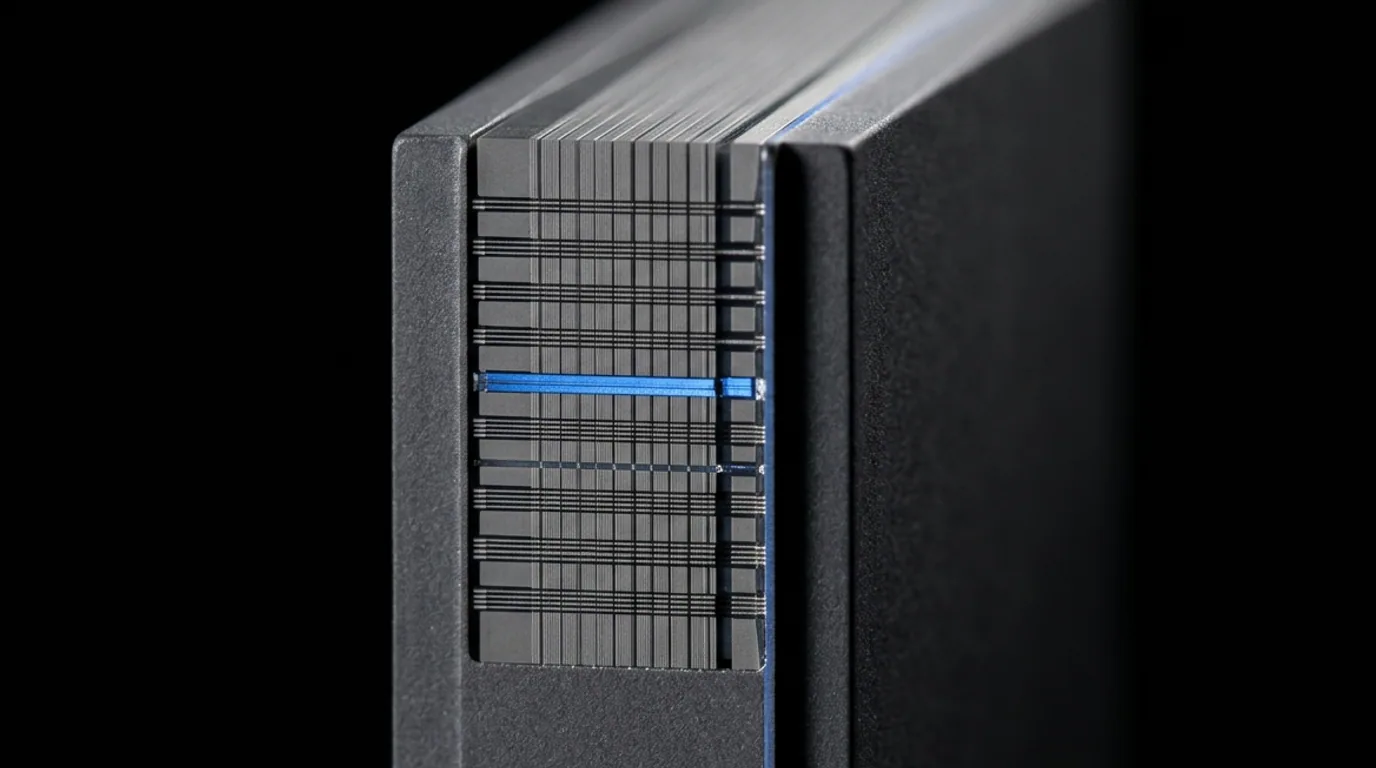
The HBM Evolution
High Bandwidth Memory has been the defining technology constraint for AI GPUs since the A100 shipped with HBM2e in 2020. Each HBM generation has roughly doubled bandwidth and capacity while increasing power efficiency. HBM3e, the current standard, represents the final iteration of the HBM3 specification with data rates up to 9.8 Gbps per pin and stack capacities up to 36 GB per stack.
HBM4, ratified by JEDEC in late 2025, is a ground-up redesign. The interface width doubles from 1,024 bits per stack to 2,048 bits, achieved through a 32-die stack with 16 channels per stack. This width increase is the primary driver of HBM4's 2 TB/s per stack bandwidth, a 2x improvement over HBM3e's roughly 1 TB/s per stack at equivalent clock speeds.
Specifications Comparison
The raw specifications tell a clear story. HBM3e achieves 9.8 Gbps data rate with a 1,024-bit interface per stack, delivering 1.2 TB/s per stack. Standard stacks range from 8 GB to 36 GB, with 6-stack configurations (216 GB) being the most common in B300 GPUs. Power consumption sits at approximately 15W per stack at full bandwidth.
HBM4 doubles the interface to 2,048 bits while targeting data rates of 6.4-7.2 Gbps in the first generation. The wider interface compensates for the lower clock speed, delivering 2.0-2.4 TB/s per stack. Initial HBM4 stacks will offer 32 GB and 48 GB capacities, with 8-stack configurations planned for future GPUs. Power consumption per stack is approximately 18-20W, a 20-33% increase despite the lower clock speed.
| Parameter | HBM3e (Current) | HBM4 (Gen 1) | HBM4 (Gen 2) |
|---|---|---|---|
| JEDEC Standard | JESD235D | JESD239 | JESD239 Rev 1 |
| Data Rate | 9.8 Gbps | 6.4 Gbps | 8.0 Gbps |
| Interface Width | 1,024 bit | 2,048 bit | 2,048 bit |
| Per-Stack BW | 1.2 TB/s | 2.0 TB/s | 2.5 TB/s |
| Max Stack Capacity | 36 GB | 48 GB | 64 GB |
| Stack Height | 12 dies | 16 dies | 32 dies |
| Per-Stack Power | ~15W | ~18W | ~22W |
| BW per Watt | 80 GB/s/W | 111 GB/s/W | 114 GB/s/W |
Manufacturing Challenges and Yield
HBM4's manufacturing complexity is the primary constraint on GPU supply through 2027 and 2028. The 32-die stack requires through-silicon vias (TSVs) with a 40% higher aspect ratio than HBM3e, reducing yield rates. Samsung reports HBM4 yield at approximately 50-60% in initial production runs, compared to HBM3e yields above 80% at mature fabs.
TSMC's CoWoS (Chip-on-Wafer-on-Substrate) interposer technology is the bottleneck. HBM4's 2,048-bit interface requires a larger interposer footprint, reducing the number of GPUs per wafer. CoWoS capacity expansion is underway in Taichung and Arizona, but production volumes will not reach parity with HBM3e until Q3 2027 at the earliest.
Cost per GB and Economic Implications
HBM memory cost per GB follows a predictable pattern: each new generation initially costs 1.5-2x more per GB than the mature previous generation. HBM4's initial cost is approximately $22-28 per GB, compared to HBM3e at $14-18 per GB. A 384 GB R100 GPU (6 stacks of 48 GB) carries roughly $8,500-10,800 in memory cost alone, versus $3,000-3,900 for a 288 GB B300.
This memory cost premium is the primary driver of GPU price inflation. The B300 NVL sells for approximately $280K per 72-GPU rack, while early R100 NVL72 pricing is projected at $2.3-2.7M, a roughly 3x increase. Memory accounts for approximately 35% of the total BOM cost in R100, up from 22% in B300.
For AI teams, the cost-per-GB trade-off matters most for memory-bound workloads. Large-batch inference and long-context serving see a direct ROI from HBM4's higher bandwidth. Compute-bound workloads (small-batch inference, dense training) may see diminishing returns from the higher memory cost, making HBM3e-equipped GPUs a better value proposition.
Workload Performance Impact
The performance impact of HBM4 varies dramatically by workload type. For memory-bandwidth-bound operations like prefill, self-attention, and large-batch inference, the 2x bandwidth improvement translates to 1.6-1.9x real-world throughput gains. For compute-bound workloads like small-batch autoregressive decoding, the gains drop to 5-15%.
KV cache bound inference sees the largest benefit. With HBM4's 384 GB capacity on the R100, a single GPU can serve 256K-token contexts for 200B+ parameter models without tensor parallelism across GPUs. This eliminates the inter-GPU communication overhead that currently limits long-context inference throughput on HBM3e GPUs. The effective throughput gain for 256K-context inference is approximately 3.2x on R100 versus B300.
Procurement Strategy Across the HBM Transition
The HBM3e to HBM4 transition creates a procurement planning challenge similar to the HBM2e-to-HBM3 transition in 2023-2024. Teams that over-invest in HBM3e hardware in late 2026 may find themselves at a competitive disadvantage as HBM4-powered GPUs deliver 2-3x cost-per-token improvements for memory-bound workloads starting in 2027.
The recommended approach is a dual-track strategy: acquire HBM3e GPUs (B300, H200) on flexible rental terms for current workloads, while placing early-deposit reservations for HBM4 GPUs (R100, R200) with a cancellation option. This hedges against both the risk of delayed HBM4 availability and the risk of being locked into expensive HBM3e contracts when HBM4 delivers the expected step change.
ClusterBid's platform supports this strategy by aggregating both current-generation HBM3e capacity and pre-production HBM4 reservations. Teams can right-size their current compute on B300 or H200 with monthly commit flexibility, then transition to R100 as HBM4 capacity becomes available in volume.