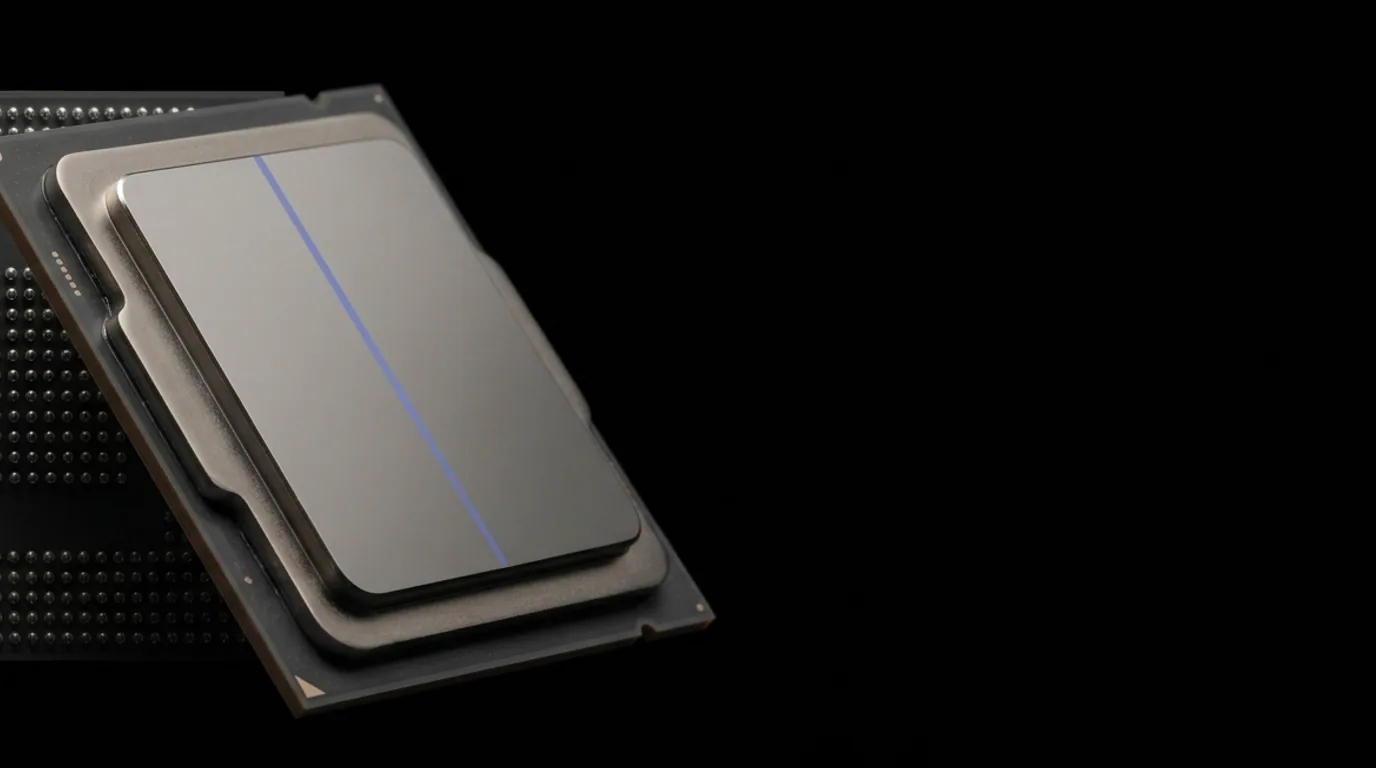
TSMC COWOS CAPACITY: THE PRIMARY BOTTLENECK
TSMC's CoWoS (Chip-on-Wafer-on-Substrate) advanced packaging remains the single most constrained node in the AI hardware supply chain through 2026. CoWoS capacity reached approximately 38,000 wafers per month (wpm) across CoWoS-S and CoWoS-L variants by Q1 2026, up from 15,000 wpm in Q1 2024. TSMC has allocated $12.4 billion in capex toward packaging capacity expansion, including the new Zhubei facility dedicated to CoWoS. The CoWoS-L variant, required for NVIDIA B200 and Blackwell Ultra (B300) chips due to their larger reticle size and die-count per interposer, is the tightest sub-node: only 14,000 wpm capacity in Q1 2026, with 70% pre-allocated to NVIDIA.
The capacity allocation breakdown shows NVIDIA commanding 62% of total CoWoS capacity (23,500 wpm), AMD at 18% (6,800 wpm), and ASIC providers including AWS Trainium, Google TPU, and custom chips at 20% combined. This concentration means any incremental CoWoS capacity expansion disproportionately benefits NVIDIA, with approximately 60-65% of new capacity coming online in H2 2026 already allocated to Blackwell Ultra MCM (multi-chip module) packaging. Neocloud providers seeking non-NVIDIA GPU supply face separate CoWoS constraints: AMD MI350X requires CoWoS-L at 2.5x the interposer area of MI300X, further squeezing the limited supply. The practical effect is that total GPU shipments in 2026 will be CoWoS-constrained at roughly 5.2-5.5 million GPU units, versus teardown-based demand estimates of 6.8-7.2 million units, creating an 18-24% supply-demand gap.
| CoWoS Variant | Q1 2025 Capacity | Q1 2026 Capacity | Q4 2026 Projected | Primary Customer | Utilization Rate |
|---|---|---|---|---|---|
| CoWoS-S | 14,000 wpm | 22,000 wpm | 28,000 wpm | AMD MI300X/MI350X | 94% |
| CoWoS-L | 6,000 wpm | 14,000 wpm | 24,000 wpm | NVIDIA B200/B300 | 98% |
| CoWoS-R | 1,500 wpm | 2,000 wpm | 3,000 wpm | Custom ASICs | 82% |
| Total | 21,500 wpm | 38,000 wpm | 55,000 wpm | - | 94% |
NVIDIA GPU ALLOCATION QUOTAS AND LEAD TIMES
NVIDIA's allocation system for enterprise and neocloud customers has evolved from a purely relationship-based model in 2024 to a tiered quota system in 2026. Each customer category receives a quarterly allocation cap based on historical purchase volume, forecasted utilization, and form factor preference. Tier 1 hyperscalers (AWS, Azure, GCP, OCI) receive 55% of total B200 and H200 GPU supply with 90-120 day lead times. Tier 2 neocloud providers (CoreWeave, Lambda, Crusoe, Together, Vultr) collectively receive 28% with 150-180 day lead times. Tier 3 enterprise direct purchasers receive the remaining 17% with 200-300 day lead times, often with minimum order quantities of 1,024 GPUs per SKU. The allocation scarcity means neocloud GPU spot prices remain elevated at $2.80-3.20/hr for H100 and $3.80-4.50/hr for B200 through H1 2026.
Lead times have compressed from the 2024 peak of 52 weeks for H100 to 16-24 weeks for H200 and 20-28 weeks for B200 as of Q2 2026. The compression is driven by CoWoS expansion, not demand softening: confirmed GPU orders continue to exceed supply by 1.4x. NVIDIA's allocation committee reviews quotas monthly against utilization telemetry data reported by customers. Customers utilizing under 70% of their allocated inventory risk 15-25% quota reductions in subsequent quarters, creating a perverse incentive to fill servers even at below-market utilization rates. This "use it or lose it" allocation policy inflates short-term GPU demand by an estimated 8-12% above efficient-market levels, as customers over-order to protect future quotas.
| Customer Tier | Supply Share | Lead Time H1 2026 | Lead Time H2 2026 | Min Order Qty | Quarterly Quota Range |
|---|---|---|---|---|---|
| Tier 1: Hyperscalers | 55% | 90-120 days | 75-100 days | 4,096 GPUs | 12K-48K per cloud |
| Tier 2: Neocloud | 28% | 150-180 days | 120-150 days | 512 GPUs | 2K-8K per provider |
| Tier 3: Enterprise | 17% | 200-300 days | 180-240 days | 1,024 GPUs | 1K-4K per customer |
HBM3E MEMORY SUPPLY AND PRICING
HBM memory is the second critical bottleneck. HBM3e 12-high (12H) stacks of 36 GB per stack are required for NVIDIA B200 (8 stacks = 288 GB) and H200 (6 stacks = 144 GB). SK Hynix leads production with 68% market share in 2026, followed by Samsung at 24% and Micron at 8%. SK Hynix's M15X fab expansion in Cheongju, South Korea, funded by $12 billion in capex, brings online 50% more HBM3e production by Q3 2026. Despite this, HBM3e remains undersupplied: total 2026 HBM bit supply is estimated at 3.8 billion GB-equivalent, against demand of 5.2 billion GB-equivalent, a 27% deficit. HBM3e pricing has stabilized at $32-38 per GB in 2026 contract markets, down from $45-55 per GB in 2024 but still 3x the per-GB cost of GDDR7.
The memory supply constraint directly limits GPU output: each B200 GPU requires 288 GB of HBM3e, meaning 3.8 billion GB of supply produces at most 13.2 million B200-equivalent GPUs annually. Since total GPU production also includes lower-memory configurations (H200 at 144 GB, L40S with GDDR6), the effective GPU cap is higher. However, the trend toward higher memory per GPU (B300 is rumored at 384 GB with 12-high HBM4 stacks due in 2027) means memory-per-GPU is growing faster than HBM bit supply, creating structural memory tightness through 2027. The 12-high HBM3e stacks have a 35-40% yield penalty versus 8-high stacks, further constraining B200 production specifically.
PROCUREMENT STRATEGIES IN A SUPPLY-CONSTRAINED MARKET
Neocloud providers have developed three procurement workarounds to NVIDIA's allocation constraints. First, second-sourcing: signing supply agreements with AMD for MI350X GPUs as a substitute for B200 in inference workloads, with AMD's allocation representing 25-40% of neocloud GPU procurement in 2026 versus 10-15% in 2024. Second, multi-year forward purchase agreements (MYPAs) with NVIDIA that guarantee allocation at 15-25% above standard tier quotas in exchange for 2-3 year volume commitments and 10-15% prepayments. CoreWeave, Lambda, and Crusoe have collectively committed over $18 billion in MYPAs with NVIDIA through 2028. Third, spot market procurement through brokers and distributors at 20-40% above NVIDIA's list price, which accounts for approximately 8-12% of neocloud GPU acquisitions.
The spot premium for immediate GPU availability tells the supply story: B200 GPUs for immediate delivery trade at $42,000-48,000 on the gray market versus NVIDIA's estimated $28,000-32,000 list price, a 40-50% premium. H100 SXM units, now a generation old, trade at $18,000-24,000 on the spot market versus $25,000-30,000 new list price in 2024, showing depreciation but maintaining 72% of original value after 24 months. The DCA (dollar-cost-averaging) procurement strategy has emerged in 2026: providers purchase smaller batches quarterly rather than lump-sum, paying the 20-40% spot premium on marginal capacity but avoiding the 200+ day enterprise lead times.
| Procurement Channel | Premium vs NVIDIA List | Lead Time | Volume Available | Payment Terms |
|---|---|---|---|---|
| Direct NVIDIA Tier 2 Quota | None (list price) | 150-180 days | 2K-8K/quarter | Net 30 |
| Multi-Year FPA (MYPA) | None + 10-15% prepay | 90-120 days | 5K-15K/quarter | 30-50% prepaid |
| OEM (Dell/HP/Lenovo) | +5-15% (OEM margin) | 120-200 days | 1K-4K/quarter | Net 30-60 |
| Broker/Distributor | +20-40% | 14-45 days | 100-1K/quarter | Full prepayment |
| Gray Market Spot | +40-60% | 7-21 days | 50-500/quarter | Full prepayment + escrow |
| Used/Secondary Market | 30-40% below list | 7-14 days | 100-2K/quarter | Net 15-30 |
H2 2026 OUTLOOK AND SUPPLY RECOVERY TIMELINE
Supply recovery is forecast in three phases. Phase 1 (Q3 2026): TSMC's Zhubei CoWoS facility adds 12,000 wpm of CoWoS-L capacity, primarily serving B300 Blackwell Ultra ramp, which will start sampling in September 2026. Phase 2 (Q4 2026): SK Hynix M15X achieves full HBM3e production, adding 30% bit supply. Phase 3 (H1 2027): Samsung's new HBM4 production line and Intel's entry into CoWoS packaging via its Ohio facility add incremental capacity. The composite effect is that GPU supply will grow from ~1.3M units shipped in Q1 2026 to ~1.7M in Q4 2026, a 31% increase, but still below demand of ~1.9M units per quarter. Full supply-demand equilibrium for data center GPUs is not expected before H2 2027.
The pricing implications are clear: GPU compute spot pricing will remain elevated through 2026, with H100 stabilizing at $2.40-2.70/hr (down from $3.00+ in 2024 but above the equilibrium price of $1.80-2.00/hr estimated by GPU economics models). B200 pricing will trade at $3.50-4.20/hr through year-end. The supply deficit favors providers with long-dated supply agreements over spot-reliant competitors, widening the margin gap between established neocloud operators and newer entrants. For GPU buyers, the strategic recommendation is to lock in 12-18 month compute contracts in Q2-Q3 2026 before H2 supply tightness re-accelerates from B300 demand pull.