The Power Density Curve: From H100 (700W) to Rubin (~1800W)
The single most important infrastructure trend in GPU hosting is hiding in plain sight: per-GPU power draw has more than doubled in three generations. The H100 SXM5 shipped at 700W TDP. The H200 lifted to 700-1000W depending on configuration. The B200 settled around 1000W. The B300 is running at approximately 1400W in NVL configurations. And the Vera Rubin architecture, sampling to partners now, is reportedly targeting approximately 1800W per GPU at the module level. Each step compounds everything downstream: power delivery, cooling, rack density, floor loading, and colocation pricing.
The implications are not linear. Doubling GPU wattage does not just double per-rack power - it pushes you past the air-cooling ceiling, changes the fire suppression requirements, and often requires a different facility class entirely. A cluster of 1,000 H100 GPUs at 700W draws 700kW of IT load. A cluster of 1,000 B300 GPUs at 1400W draws 1.4MW - the same count, twice the facility power, and a cooling architecture that most existing data centers cannot deliver without retrofit.
This trend is what we described in our piece on the <a href="https://clusterbid.com/blog/the-1800w-gpu-tax-how-rubin-era-power-density-is-splitting-the-gpu-hosting-marke" style="color:var(--orange);text-decoration:underline">1800W GPU tax</a> - the structural cost premium that Rubin-era hardware imposes on hosting. That article focused on the pricing implications. This one focuses on the physical infrastructure: what actually changes in the data center when you go from 700W to 1800W per GPU.
Where Air Cooling Breaks: The 20-25 kW Per Rack Ceiling
Standard air-cooled data center design, as built in the 2010-era colocation boom, targets 5-15 kW per rack for typical enterprise compute. Premium air-cooled facilities - the ones that advertised themselves as 'high density' - pushed this to 20-25 kW per rack using hot-aisle containment, raised-floor plenums with high-flow perforated tiles, and row-based CRAC or CRAH units. That design envelope accommodated the A100 (400W) and early H100 (700W) generations reasonably well, as long as you did not densely pack them.
A B300 NVL72 rack draws approximately 140kW of IT load (72 GPUs at 1400W plus NVSwitch and host overhead). That is 5-7x what a premium air-cooled rack position can deliver. Even at reduced packing - say 16 B300 GPUs per rack with spacing - you are at 22-28 kW, which is at or above the ceiling of most air-cooled designs. The reality is that Blackwell Ultra and Rubin-class hardware forces liquid cooling. There is no air-cooled path for these GPUs at any commercially reasonable packing density.
For buyers shopping for GPU hosting in 2026, the first question should not be 'what is your per-GPU price' - it should be 'what is your maximum rack density and what cooling method do you use.' If the answer is air cooling with a maximum above 30 kW per rack, you are likely looking at a facility that cannot host B200 or later GPUs at scale. That facility may still be fine for H100 workloads, but the depreciation clock on air-cooled GPU capacity is ticking.
Direct-to-Chip vs Immersion: The Cost and Performance Tradeoff
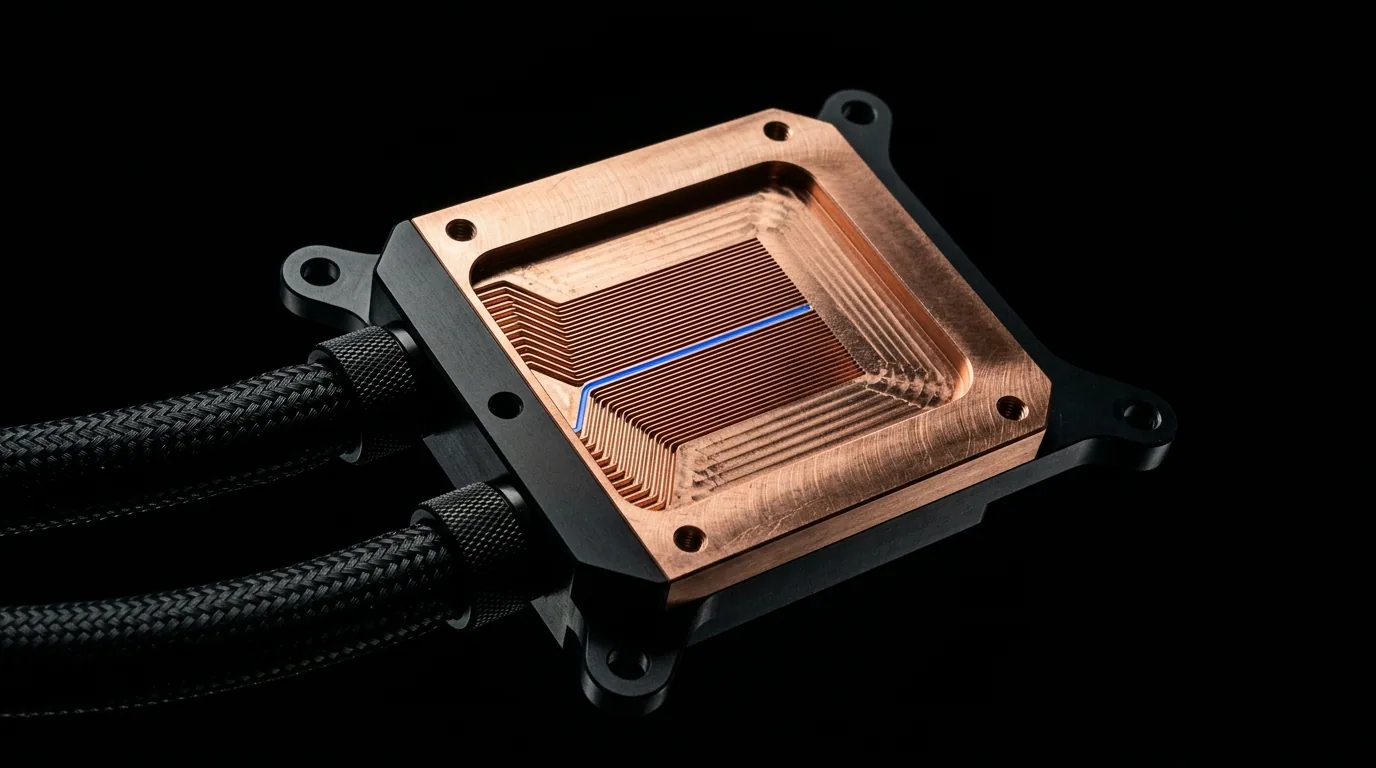
Liquid cooling for GPU clusters comes in two primary architectures. Direct-to-chip (cold-plate) liquid cooling circulates a coolant through cold plates mounted directly on the GPU and CPU packages, removing heat at the source via a facility-level coolant distribution unit (CDU) and dry cooler or chiller plant. Single-phase DLC uses water-glycol or dielectric fluid and keeps the fluid in liquid state throughout the loop. Two-phase DLC allows the coolant to boil and condense, capturing latent heat for higher efficiency. Immersion cooling submerges entire servers in a dielectric fluid bath, with heat transferred through the fluid to a heat exchanger.
Direct-to-chip is the dominant architecture for GPU deployments in 2026. It is the approach NVIDIA validates for DGX and NVL reference designs. It delivers 80-100 kW per rack with standard CDU configurations, integrates with existing facility chilled-water loops, and allows individual GPU serviceability without draining a tank. The capital cost typically runs $2.0-3.5M per MW of IT load, depending on whether you are retrofitting an existing data center or building new. Retrofits add 20-40% cost premium because of ceiling height, floor reinforcement, and piping pathway constraints.
Immersion cooling can handle 150+ kW per rack and is theoretically more efficient at extreme densities. But it has adoption friction in 2026: GPU warranty coverage is inconsistent when submerged, service operations require robotic or manual extraction from fluid tanks, and the dielectric fluid itself is a consumable cost that runs $50-80 per gallon with annual replacement volume of 5-10% of the system inventory. For most GPU buyers, DLC is the practical choice. Immersion makes sense for tightly packed inference clusters or facilities that are building new from the ground up with immersion as a design constraint.
Rack Density at Scale: 40kW/Host to 140kW/Rack for B300 NVL72
The rack density numbers that matter in 2026: a standard 42U rack hosting 8x H100 SXM5 servers with networking draws approximately 11-13 kW. That same rack footprint with a B300 NVL72 - the 72-GPU NVLink domain in a single rack enclosure - draws approximately 140 kW. That is a 10-12x density increase in the same physical footprint. The floor loading jumps from roughly 150-200 lbs/sq ft to 400-500 lbs/sq ft for the NVL72 rack.
The GPU host density progression across generations tells the story: H100 deployments (8x per server, 1-2 servers per rack) deliver 5-13 kW per rack. H200 at 8x per server pushes 11-18 kW per rack. B200 at 4-8x per server with liquid cooling reaches 20-60 kW per rack. B300 NVL72 delivers 140 kW per rack as a single system. Rubin NVL144 or NVL288 rack-level systems are expected to push 200-300 kW per rack in 2027-2028.
What this means for buyers: the concept of a 'standard GPU rack' is dead. If you are procuring a 1,000-GPU cluster, the H100 version occupies 10-14 racks. The B300 NVL72 version occupies 14 racks, but each rack costs 10x more in facility power and cooling. The total facility power requirement is roughly the same (1.4MW vs 1.0-1.3MW for H100), but the cooling infrastructure is entirely different. You cannot drop B300 NVL72 racks into an H100 air-cooled deployment without redesigning the power distribution, cooling loops, and floor reinforcement.
Cooling Infrastructure Cost: The $2-5M Per MW Reality
Liquid cooling infrastructure carries a capital cost that many GPU buyers underestimate. The table below captures realistic mid-2026 pricing for the primary cooling architectures, including CDUs, piping, dry coolers or chillers, installation labor, and the facility modifications required. These are all-in per-MW figures for the cooling system only - they exclude the IT equipment itself and the base building power infrastructure (transformers, switchgear, UPS).
The range matters. Direct-to-chip in a new build can land at $2.0-2.8M per MW. The same architecture in a retrofit hits $3.0-3.5M per MW because you are running coolant loops through existing ceiling and floor spaces, often with crane-access complications and limited pipe chase capacity. Immersion new build at $3.5-5.0M per MW reflects the tank systems, fluid inventory, and more complex heat rejection. Hybrid approaches - air cooling for lower-density racks with DLC for high-density GPU racks - sit at $1.5-2.5M per MW and are the pragmatic choice for facilities transitioning from air to liquid.
| Cooling Method | Cost per MW | Max Rack Density |
|---|---|---|
| Air Cooling (CRAC/CRAH) | $0.5 - 1.0M | 20-25 kW |
| Hybrid Air + DLC | $1.5 - 2.5M | 40-60 kW |
| Direct-to-Chip Liquid (new) | $2.0 - 2.8M | 80-100 kW |
| Direct-to-Chip Liquid (retrofit) | $3.0 - 3.5M | 80-100 kW |
| Immersion Cooling (new) | $3.5 - 5.0M | 150+ kW |
Facility Readiness Checklist: Six Things to Verify Before You Sign
Every GPU hosting contract signed in 2026 should be conditioned on a facility readiness assessment that covers at least six domains. Power: does the facility have the utility feed capacity for your target IT load, and is it delivered at the voltage and phase your PSUs require? A 10MW deployment needs a medium-voltage feed from the utility, not a standard 480V service. Many colocation providers quote based on available breaker capacity without confirming the utility transformer or upstream substation can handle the incremental load.
Cooling: is the facility liquid-cooling ready or does it need retrofit? Verify that the chilled-water loop has sufficient capacity and the CDU placement does not compete with your rack space. Ceiling height matters - DLC overhead piping trays need 12-18 inches above the rack, and immersion deployment requires 8-12 foot ceiling clearance above the rack for extraction equipment. Floor loading: verify the raised-floor or slab rating. A B300 NVL72 rack at 3,000+ lbs with concentrated weight on casters can exceed standard 250 lbs/sq ft raised-floor ratings. Concrete slab with load-spreading plates may be required.
Fire suppression: GPU clusters with liquid cooling require a fire suppression strategy that accounts for both the IT equipment and the coolant system. Standard VESDA or pre-action sprinkler systems may not be adequate if dielectric fluid is present. Verify that the facility's suppression approach is compatible with your hardware warranty. Power distribution: confirm that the per-rack power delivery (busway, PDU, or whip) supports your target draw without daisy-chaining. A 140 kW rack needs dedicated 225A or higher three-phase circuit. And finally, redundancy: ask for the specific N+1 or 2N paths for both power and cooling, not just a marketing claim. Our <a href="https://clusterbid.com/blog/liquid-cooling-and-gpu-data-centers-what-blackwell-buyers-must-verify-before-sig" style="color:var(--orange);text-decoration:underline">liquid cooling data center verification guide</a> covers the detailed walkthrough for each domain.
Colocation vs Build-Your-Own: The Total Cost of Hosting Decision
For teams evaluating whether to colocate their GPU cluster in a third-party data center or build their own facility, the decision hinges on scale, timeline, and capex tolerance. Colocation in a liquid-cooled data center typically runs $5,000-12,000 per month per rack for a 40-80 kW GPU rack, including power (at $0.08-0.15/kWh), cooling, and basic cross-connects. At a 60 kW rack drawing 43,200 kWh/month, the power component alone is $3,500-6,500/month. The colo margin sits in the spread between wholesale power cost and your rate.
Build-your-own makes sense at a cluster scale above 5-10MW of IT load, assuming a 12-18 month construction timeline and $10-15M per MW in total facility construction cost (including shell, power infrastructure, cooling plant, and fire suppression). That is a $50-150M project for a 10MW GPU facility. At that scale, the per-MW operating cost can be 20-35% lower than colocation, but the risk and timeline commitment are substantial. Zoning, utility interconnection studies, transformer lead times (36-52 weeks for large pad-mount units in 2026), and construction labor availability are all bottlenecks.
The hybrid model gaining traction in 2026 is colocation with a build-to-suit lease. The tenant commits to a 5-10 year lease for a dedicated data hall that the colo provider constructs to the tenant's specifications (liquid cooling loop, specific rack density, fire suppression type). This avoids the construction risk and timeline of a greenfield build while securing a facility built for GPU density. The pricing typically lands between retail colocation and build-your-own on a per-kWh basis. For most GPU buyers - teams procuring 500-5,000 GPUs - this is the most capital-efficient path. For a full walkthrough of deployment timelines, see our <a href="https://clusterbid.com/blog/gpu-cluster-commissioning-timelines-in-2026-from-po-signature-to-first-training" style="color:var(--orange);text-decoration:underline">GPU cluster commissioning guide</a> and our <a href="https://clusterbid.com/blog/gb200-nvl72-vs-gb300-nvl72-the-rack-scale-gpu-buyers-guide-for-2026" style="color:var(--orange);text-decoration:underline">GB200 vs GB300 rack-scale buyer's guide</a>.