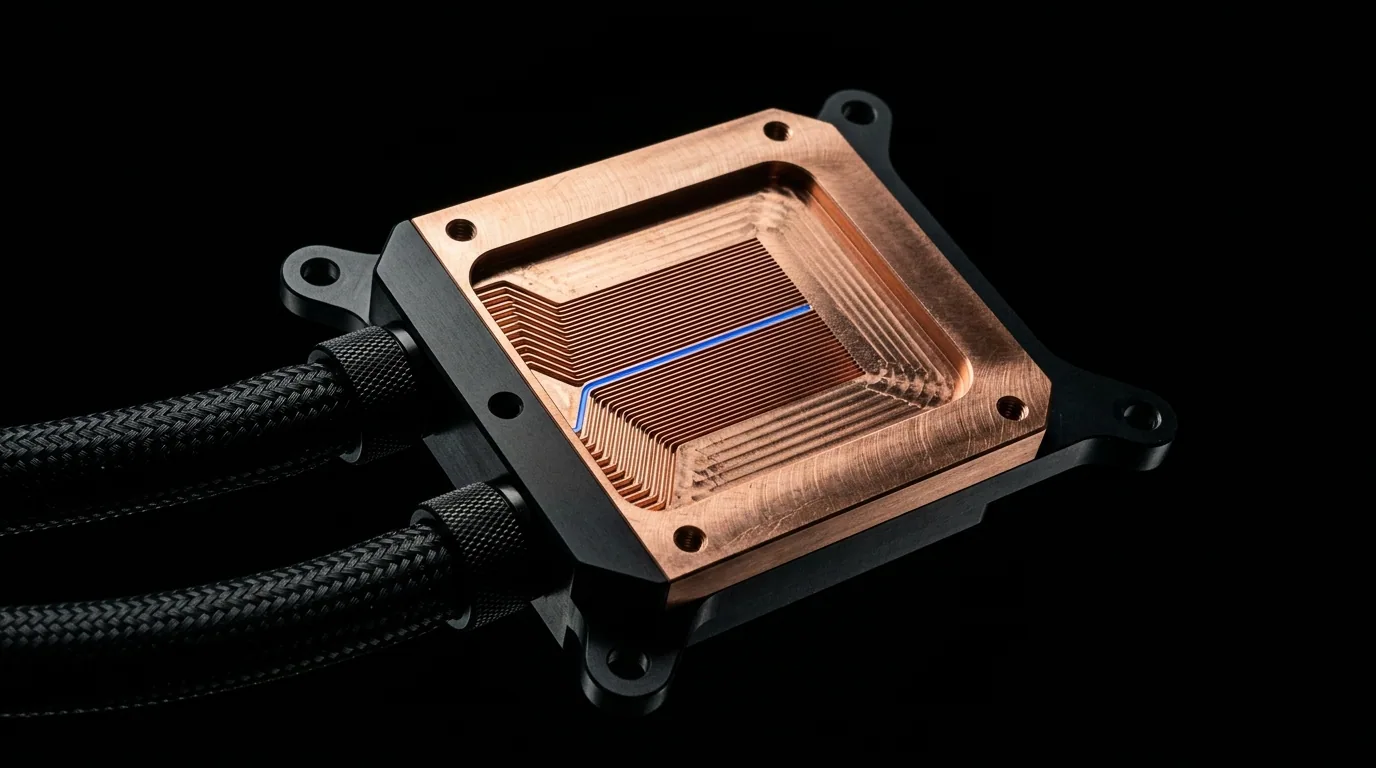
The Blackwell Cooling Challenge: 120kW+ Per Rack
NVIDIA's Blackwell architecture has shifted the GPU cooling conversation from optional to mandatory. The B200 SXM6 module dissipates up to 1,000W per GPU at peak load, and a fully populated 72-GPU DGX GB200 NVL72 rack exceeds 120kW of thermal load - comparable to a small office building in a single 24U form factor. Air cooling at these densities is physically impractical: the required volumetric airflow exceeds 6,000 CFM per rack, and the noise levels approach 95 dBA. Every major B200 deployment in mid-2026 uses direct-to-chip liquid cooling for the GPU modules, with a secondary coolant loop connecting rack-level CDUs to facility chilled water infrastructure.
The coolant distribution unit (CDU) is the critical component mediating between the server-level liquid cooling loop and the facility's heat rejection system. A single CDU for an NVL72 rack must handle 120-140kW of heat load at a flow rate of 60-100 liters per minute (LPM) with a supply water temperature of 18-25°C and a return temperature of 35-45°C. The CDU contains a plate heat exchanger, circulation pumps (typically 2N redundant), coolant reservoir, expansion tank, filtration system (50-micron minimum, 10-micron recommended), and instrumentation for flow, temperature, pressure, and conductivity monitoring.
The mid-2026 market for GPU cooling infrastructure has matured significantly. CoolIT, Boyd (formerly Aavid), and Motivair dominate the high-density GPU CDU market, with units ranging from 100kW (single-rack) to 1MW (multi-rack manifold). ClusterBid now offers pre-configured liquid-cooled H100 and B200 rack bundles that include CDU, coolant, and facility connection kits - addressing the most common deployment friction point: facility plumbing readiness.
Coolant Chemistry: Deionized Water vs Propylene Glycol
The secondary loop coolant decision is the most consequential fluid engineering choice in a GPU liquid cooling deployment. Two options dominate: deionized (DI) water with corrosion inhibitors and biocides, or propylene glycol/water mixtures (typically 25-40% glycol by volume). DI water has superior thermal properties - specific heat capacity of 4.18 kJ/kg·K versus 3.6-3.8 kJ/kg·K for 30% propylene glycol, and thermal conductivity of 0.6 W/m·K versus 0.4-0.45 W/m·K. The practical implication: for the same heat load, a DI water system requires 8-12% lower flow rates than a propylene glycol system, meaning smaller pumps and lower pumping power.
The argument for propylene glycol centers on three failure modes: freeze protection (important for data centers in cold climates with outdoor dry coolers), biological growth resistance (glycol is bacteriostatic, reducing the need for periodic biocide dosing), and leakage detection (glycol has a sweet odor that makes small leaks easier to find than DI water). NVIDIA's DGX liquid cooling installation guide recommends 30% propylene glycol as the default coolant for data center connections, with DI water acceptable only for fully indoor, freeze-protected loops with continuous conductivity monitoring and UV biocide treatment.
Coolant chemistry maintenance is a recurring operational cost that GPU teams routinely underestimate. DI water loops require monthly conductivity checks (target <1 µS/cm), quarterly biocide re-dosing, and annual full coolant replacement. Propylene glycol loops require annual specific gravity measurement (to verify concentration hasn't shifted due to evaporation), biannual inhibitor pack testing (nitrite/molybdate levels for corrosion protection), and replacement every 3-5 years. Corrosion coupons installed in the coolant loop provide the earliest warning of material incompatibility - the most common failure is galvanic corrosion between the nickel-plated copper cold plates (GPU blocks) and the aluminum radiator cores used by some facility CDUs.
| Property | Deionized Water + Inhibitors | 30% Propylene Glycol |
|---|---|---|
| Specific Heat (kJ/kg·K) | 4.18 | 3.7 |
| Thermal Conductivity (W/m·K) | 0.60 | 0.43 |
| Viscosity at 20°C (cP) | 1.0 | 2.8 |
| Freeze Protection | 0°C (freezes at 0°C) | -15°C |
| Biocide Requirement | Monthly dosing | Annual |
| Loop Replacement Interval | 1 year | 3-5 years |
| Pumping Power (relative) | 1.0x (baseline) | 1.3-1.5x |
| Leak Detection | Conductivity sensors | Odor + sensors |
| GPU OEM Recommendation | NVIDIA allows | NVIDIA recommended |
Flow Rates, Delta-T, and Pump Sizing for 120kW+ Racks
The fundamental CDU sizing equation is straightforward: Q (heat load in kW) = ṁ (mass flow rate in kg/s) × Cp (specific heat in kJ/kg·K) × ΔT (temperature rise across the rack in °C). For a 120kW NVL72 rack using 30% propylene glycol (Cp = 3.7 kJ/kg·K) with a ΔT of 12°C (18°C supply, 30°C return): required mass flow = 120 kW / (3.7 kJ/kg·K × 12°C) = 2.7 kg/s = 162 LPM. This is significantly higher than the flow rate for a same-density air-cooled rack, but the cooling density per liter of coolant far exceeds air's heat capacity per cubic meter.
Pump sizing must account for total system pressure drop: the GPU cold plates (typically 5-15 kPa drop each, 72 in series-parallel), the CDU heat exchanger (30-50 kPa), piping runs to the rack (10-30 kPa depending on distance and pipe diameter), and elevation head. A 72-GPU NVL72 rack with parallel cold plate branches and CDU-internal losses typically requires a pump delivering 3-5 bar (45-75 PSI) at the design flow rate. Most CDUs for this application use dual variable-speed pumps in 1+1 redundant configuration, with the pumps sized at 60% duty cycle to allow for future capacity increases.
The delta-T across the rack is the primary lever for reducing flow rate requirements - and teams frequently get it wrong. Operating at a higher delta-T (18°C supply, 40°C return = 22°C ΔT) cuts the required flow rate by roughly 45% compared to a 12°C ΔT. However, higher return temperatures increase the GPU junction temperature, which degrades performance: H100/B200 GPUs begin thermal-throttling at 85°C junction temperature, and the GPU's boost clock is temperature-dependent above 65°C. Running a 22°C ΔT in a warm data center (22°C supply air) pushes GPU baseplate temperatures to 75-80°C, leaving only 5-10°C of thermal margin before throttling. The standard recommendation for Blackwell GPU racks: design for 12-15°C ΔT with 18-22°C supply temperature, yielding 60-65°C GPU junction temperature and full boost clock operation.
CDU Placement and Facility Plumbing Requirements
CDU placement relative to the GPU rack determines the secondary loop pressure drop, pump sizing, and the facility floor space allocation. In-rack CDUs sit within the GPU rack envelope (typically occupying 4-6U of the 24U NVL72 frame), minimizing external plumbing to a few feet of hose. The tradeoff: reduced space for compute within the rack, higher rack-level power density requiring heavier branch circuit wiring, and more challenging service access. Row-end CDUs (mounted at the end of a row of 2-4 GPU racks) offer easier service access and shared cooling for multiple racks but require overhead or underfloor coolant supply/return piping running the length of the row.
Facility plumbing interface is the most common cause of liquid cooling deployment delays. The CDU's facility-side loop (primary loop) connects to the building's chilled water system, typically requiring 1.5-2 inch supply and return lines per 100-150kW of cooling capacity. Each connection point needs a shutoff valve, strainer (200 micron minimum), pressure gauge, temperature probe, and flow meter. Most data centers built before 2024 lack the overhead piping infrastructure for liquid-cooled racks, requiring trenching or overhead rack installation - a 4-8 week construction project per row in a retrofit scenario. New-build data center capacity coming online in 2026 typically includes pre-plumbed liquid cooling manifolds at every rack location.
The condenser water approach is an alternative for facilities without chilled water access. In this configuration, a dry cooler or cooling tower rejects heat directly to the atmosphere, and the CDU's primary loop connects to the condenser water rather than building chilled water. This eliminates the dependency on facility chiller capacity but requires outdoor equipment placement (dry cooler on the roof or adjacent lot), pump houses for long-distance coolant circulation, and freeze protection for the outdoor piping. The condenser water approach adds $50,000-150,000 in upfront equipment cost per 500kW of GPU cooling capacity but decouples the GPU deployment timeline from the facility chiller upgrade queue, which can reduce deployment lead time by 8-16 weeks.
Leak Detection and Containment: The GPU-Killing Failure Mode
A coolant leak in a live GPU rack is a catastrophic failure mode. Propylene glycol is conductive enough to short circuit GPU PCB traces, and DI water with even trace ion contamination is similarly destructive. The standard leak detection architecture for GPU racks uses three layers: (1) in-line conductivity sensors at every coolant line connection point, continuously monitoring for changes that indicate the onset of a leak; (2) drip detection cables (water-sensing ropes) deployed along the bottom of every server tray and along the rack floor edge; and (3) humidity sensors inside the GPU chassis, detecting the localized humidity change from evaporating coolant.
Automated response is non-negotiable. When a leak is detected, the CDU controller must: shut off the affected zone's coolant supply valve (within 500ms), power-off the affected GPU server tray via the rack PDU (within 2 seconds), and alert facility operations via both network-based alerting and hardwired alarm contacts. The entire response sequence must complete before the leaked coolant migrates to adjacent trays or the subfloor. Gas-phase leak detection using photoacoustic sensors tuned to glycol's infrared absorption signature adds an early warning layer that detects micron-level coolant vapor in the air before any liquid accumulates.
Coolant choice affects leak severity. Propylene glycol is less immediately conductive than water - its resistivity is roughly 10-20 kΩ·cm versus DI water's 1-10 MΩ·cm (glycol naturally dissociates slightly). However, as glycol absorbs atmospheric moisture, its resistivity drops further. The practical difference: a DI water leak will short circuit a powered GPU within seconds; a glycol leak may take 30-120 seconds to cause damage, providing a critical window for automated shutdown. This is another reason NVIDIA's installation guidelines recommend propylene glycol despite its inferior thermal properties.
CDU Monitoring and Control: The Operational Data Layer
A modern GPU CDU generates roughly 50-100 telemetry points, of which approximately 15 are critical for operational decision-making: supply and return temperature on both loops, flow rate (primary and secondary), pump differential pressure, pump speed (%), heat exchanger approach temperature, reservoir level, coolant conductivity, and GPU inlet coolant temperature. These metrics should feed into a thermal management dashboard with automatic anomaly detection - a gradual increase in heat exchanger approach temperature (difference between primary loop supply and secondary loop return) indicates fouling of the heat exchanger plates, which requires cleaning every 12-18 months.
Pump speed control strategy directly affects GPU performance consistency. Most CDUs use PID-based pump speed control targeting a constant GPU inlet temperature. The setpoint is typically 18-22°C, and the control loop adjusts pump speed in response to GPU heat load changes. A poorly tuned PID loop can cause GPU inlet temperature oscillations of 2-4°C, which translate to GPU clock speed fluctuations of 50-100 MHz - measurable as 3-5% throughput variation in GPU compute benchmarks. Adaptive pump control (feed-forward based on GPU power draw telemetry) is superior to reactive PID for GPU workloads with rapid load changes, such as training jobs that alternate between compute-heavy and communication-heavy phases.
The integration between the CDU controller and the cluster orchestration layer (SLURM, Kubernetes, or a GPU scheduling platform) determines whether thermal events become service interruptions or graceful capacity adjustments. When a CDU approaches its cooling capacity limit (supply temperature rising above the setpoint at maximum pump speed), the orchestration system should proactively reduce GPU power limits via NVIDIA's NVML API before thermal throttling forces an uncontrolled performance drop. A thermal-aware scheduler that models CDU cooling capacity as a scheduling constraint - analogous to how SLURM models GPU memory - prevents the orchestration system from over-provisioning compute on a rack that cannot thermally support it.
Total Cost of Cooling: CDU CAPEX and OPEX for Mid-2026
The capital cost of liquid cooling infrastructure for GPU racks is non-trivial but has dropped significantly as production volumes increased through 2025-2026. A 120kW CDU for a single NVL72 rack costs approximately $35,000-55,000 including the plate heat exchanger, pumps, reservoir, filtration, and control system. Installation and facility connection add $15,000-30,000 per rack for the piping, valves, and electrical work. The per-GPU cooling cost for a B200 rack works out to approximately $700-1,200 per GPU - roughly 3-5% of the GPU hardware cost at mid-2026 pricing.
Operating expenses for liquid cooling include pumping power (the CDU pumps consume 2-5kW per 100kW of cooling capacity, or about 3% of the IT load), coolant replacement (propylene glycol at approximately $15-25 per liter, with 30-50L per rack, replaced every 3-5 years), and maintenance labor (quarterly inspection and annual heat exchanger cleaning, roughly $2,000-4,000 per rack per year). The total OPEX for liquid cooling is approximately $0.005-0.01 per GPU-hour, compared to $0.008-0.015 per GPU-hour for air cooling at the same power density. Liquid cooling is slightly cheaper to operate at H100 power densities (700W per GPU) and significantly cheaper at B200 densities (1,000W per GPU).
The total cost of ownership analysis for mid-2026 GPU deployments is unambiguous: for racks above 40kW density, liquid cooling has lower TCO than air cooling, with breakeven occurring at 18-24 months. For clusters designed around B200, the TCO advantage of liquid cooling is approximately 8-12% lower than air cooling over a 4-year equipment lifecycle. ClusterBid offers pre-configured liquid-cooled GPU bundles that include CDU, coolant fill, facility connection kit, and leak detection system - removing the procurement fragmentation that historically made liquid cooling adoption more complex than the technology itself justifies.