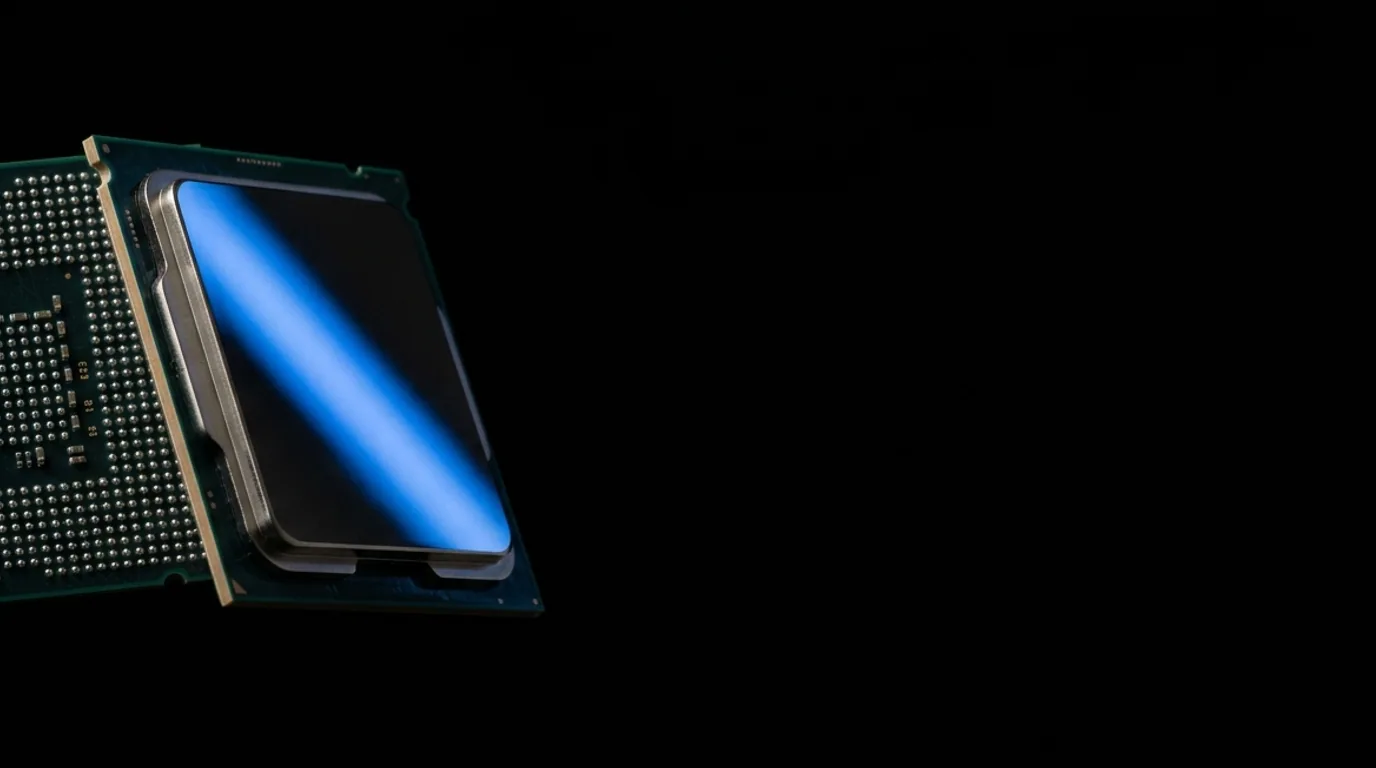
The Wafer-Scale Thesis
Cerebras WSE-3 is a single silicon wafer containing 4 trillion transistors, 900,000 AI-optimized compute cores, and 46 GB of on-wafer SRAM. It delivers 125 petaflops of sparse AI compute on one chip. By eliminating the need to shard models across multiple discrete GPUs connected via a network fabric, Cerebras removes the two dominant overheads of GPU cluster training: communication synchronization (all-reduce across nodes) and memory capacity constraints (model parallelism due to per-GPU VRAM limits). For workloads that fit within the 46 GB on-wafer SRAM, the WSE-3 achieves near-linear scaling efficiency.
The GPU alternative is a cluster of discrete accelerators connected via NVLink, InfiniBand, or Ethernet. An 8-GPU H200 node with NVLink 4 provides 900 GB/s per-GPU interconnect bandwidth and 141 GB HBM3e per GPU. A B200 node provides 1.8 TB/s NVLink 5 bandwidth and 288 GB per GPU. The GPU paradigm requires model parallelism (tensor, pipeline, or data parallelism) to distribute a model across GPUs when it exceeds single-GPU memory, adding communication overhead that reduces scaling efficiency. A 1,024-GPU H200 cluster typically achieves 45-55% scaling efficiency relative to a single-GPU baseline for models above 175B parameters.
Training Throughput Benchmarks
For GPT-3 175B training, a single Cerebras CS-3 system (one WSE-3 wafer) achieves approximately 1.9 million tokens per second using data-parallel training with weight streaming. To match this throughput with GPUs, a cluster of 64 H200 GPUs (8 nodes of 8 GPUs) is required, achieving approximately 2.1 million tokens per second with fully sharded data parallelism (FSDP) and tensor parallelism of 8. The 64-GPU H200 cluster costs approximately $2.3-3.2 million at 2026 market rates versus approximately $2.5-3.0 million for a CS-3 system. The token-throughput-per-dollar is roughly equivalent at this scale.
The advantage shifts when the model does not fit in on-wafer SRAM. GPT-3 175B has 175B parameters at FP16, requiring 350 GB of model parameters plus optimizer states and gradients (approximately 700 GB total for training). The WSE-3's 46 GB on-wafer SRAM cannot hold the full model, requiring the Cerebras weight streaming approach where parameters are streamed from external memory onto the wafer layer by layer. This adds a 15-25% throughput penalty compared to a model that fits entirely on-wafer. For models under 10B parameters that fit fully in on-wafer SRAM, the WSE-3 delivers approximately 3-4x the tokens-per-second-per-dollar of an equivalently priced GPU cluster.
| Metric | Cerebras CS-3 (WSE-3) | 64x H200 Cluster | 32x B200 Cluster |
|---|---|---|---|
| Training throughput (GPT-3 175B) | 1.9M tok/s | 2.1M tok/s | 3.4M tok/s |
| Training throughput (LLaMA-3 8B) | 6.8M tok/s | 1.4M tok/s | 2.3M tok/s |
| Model capacity (full on-chip) | 10B params | 175B params (via TP) | 200B+ params |
| System cost (estimated) | $2.5-3.0M | $2.3-3.2M | $3.5-4.5M |
| Power consumption | 45 kW | 112 kW | 96 kW |
| Floor space | 1 rack | 4 racks | 2 racks |
The Memory Wall: Where WSE Hits Limits
The WSE-3's defining constraint is the 46 GB on-wafer SRAM. This is fast (20+ TB/s bandwidth, approximately 4-5x the H200's HBM3e bandwidth) but limited in capacity. Any training job that requires storing model parameters, optimizer states, gradients, activations, and the KV cache for the full model in on-chip memory must fit within 46 GB. At FP16, that limits full on-chip training to approximately 10-12 billion parameters. Larger models require weight streaming, which loads parameters from external DRAM onto the wafer layer by layer during the forward and backward passes.
GPUs face the opposite tradeoff. Each H200 has 141 GB HBM3e at 4.8 TB/s bandwidth. A model like DeepSeek-V4 (1 trillion MoE parameters, 37B active) fits across 4 H200s with tensor parallelism because the active parameters per token are only 37B. The GPU memory wall is an interconnect wall: once a model exceeds single-GPU memory, the GPU cluster's performance is bounded by NVLink or InfiniBand bandwidth for gradient synchronization and attention computation. For MoE models with large expert counts, the all-to-all communication across experts becomes the bottleneck, reducing GPU scaling efficiency to 35-45% at 128+ GPU counts.
Scaling: Single System vs Multi-Node GPU
The Cerebras scaling model is single-system: one CS-3 performs the training. To scale further, you add more CS-3 systems in a data-parallel configuration, but each system trains independently and synchronizes gradients via Ethernet. Cerebras has demonstrated up to 16 CS-3 systems (16 wafers) training together, but the synchronization overhead grows linearly with the number of systems. The practical maximum for single-job throughput is approximately 16 wafers before communication overhead erodes returns.
GPU clusters scale to thousands of GPUs using hierarchical parallelism: data parallelism across nodes, tensor parallelism within a node, pipeline parallelism across nodes, and expert parallelism for MoE models. A 1,024-GPU H100 cluster using InfiniBand NDR400 with adaptive routing achieves approximately 50% scaling efficiency for GPT-3 175B training at 1,024 GPUs relative to 8 GPUs. The advantage is flexibility: GPU clusters can be reconfigured for different model sizes by changing the parallelism strategy, while a CS-3 system is fixed at one wafer with weight streaming for oversize models.
Economic Comparison: Total Training Cost
The total cost to train a model on either platform depends on training duration, power, and engineering overhead. For a 10B-parameter model that fits on a single CS-3 wafer (e.g., LLaMA-3 8B training from scratch), the Cerebras system completes training in approximately 2-3 days versus 8-12 days on a 64-GPU H200 cluster. The per-training-run cost including power and engineering time is roughly $95,000 on CS-3 versus $310,000 on H200, a 3.3x cost advantage driven primarily by the shorter wall-clock training time.
For a 175B-parameter model (GPT-3 scale), the CS-3 requires weight streaming, adding 6-8 days to training time compared to on-wafer capacity models. The GPU cluster completes the same training in 24-28 days on 64 H200s. The total cost including power, networking, and engineering: approximately $2.1M on CS-3 versus $1.8M on H200. The GPU cluster wins on raw training FLOP utilization at this scale because weight streaming overhead erases the wafer-scale advantage. The B200 cluster at 32 GPUs completes the same training in 14-16 days at approximately $1.5M, making it the most cost-effective option for 100B+ parameter training.
| Training Scenario | Cerebras CS-3 | 64x H200 Cluster | 32x B200 Cluster |
|---|---|---|---|
| 10B model (on-chip fit) | $95K / 3 days | $310K / 10 days | $220K / 6 days |
| 70B model (weight stream) | $860K / 12 days | $950K / 16 days | $680K / 9 days |
| 175B model (GPT-3 scale) | $2.1M / 22 days | $1.8M / 26 days | $1.5M / 15 days |
| Power cost per day | $1,080 | $2,700 | $2,300 |
| Engineering overhead | Low (single system) | Medium (parallelism tuning) | Medium |
Workload Fit Analysis
Cerebras WSE-3 is best suited for models under 10B parameters that fit entirely in on-wafer SRAM, workloads that benefit from deterministic training (no floating-point rounding differences across GPUs since there is only one chip), and organizations that want to avoid the operational complexity of managing a multi-node GPU cluster. The weight streaming path extends this to approximately 70B parameters with a throughput penalty. Cerebras deployment requires a specialized hardware purchase ($2.5M+), proprietary software stack, and the operational burden of managing an on-premise or colocated system.
GPU clusters are better suited for models above 100B parameters, workloads that benefit from GPU-optimized frameworks (PyTorch FSDP, DeepSpeed, Megatron), multi-tenant environments where different teams train different-sized models, and organizations that prefer a rental/spot market model to avoid hardware ownership. The GPU market's liquidity (ClusterBid alone lists 30+ GPU types from 50+ providers) means cluster configurations can be optimized per workload and changed monthly. For most AI teams in 2026, a GPU cluster remains the more flexible platform, with the Cerebras option reserved for very specific high-throughput, small-model training pipelines.
Recommendation: When Each Platform Wins
Buy a Cerebras CS-3 if you train the same 5-10B parameter model repeatedly (fine-tuning cycles, continuous pretraining of a fixed architecture) at high volume and your team has the operational capacity to manage a specialized hardware system. The per-training-run cost savings versus GPU clusters are significant at this model size, often 3-4x, and the shorter training time improves iteration speed for research teams.
Rent GPU capacity for everything else. The flexibility of GPU clusters covers the full spectrum from 1B-parameter fine-tuning to 1T-parameter MoE training, with a liquid market that adjusts to workload needs. GPU clusters win at models above 70B parameters, multi-tenant environments, and organizations that value capacity flexibility over peak single-system throughput. At ClusterBid mid-2026 rates, a 32-GPU B200 cluster at $5.45/GPU/hr completes most training runs at a lower total cost than a CS-3 system amortized over a year of continuous operation, with zero hardware commitment risk.