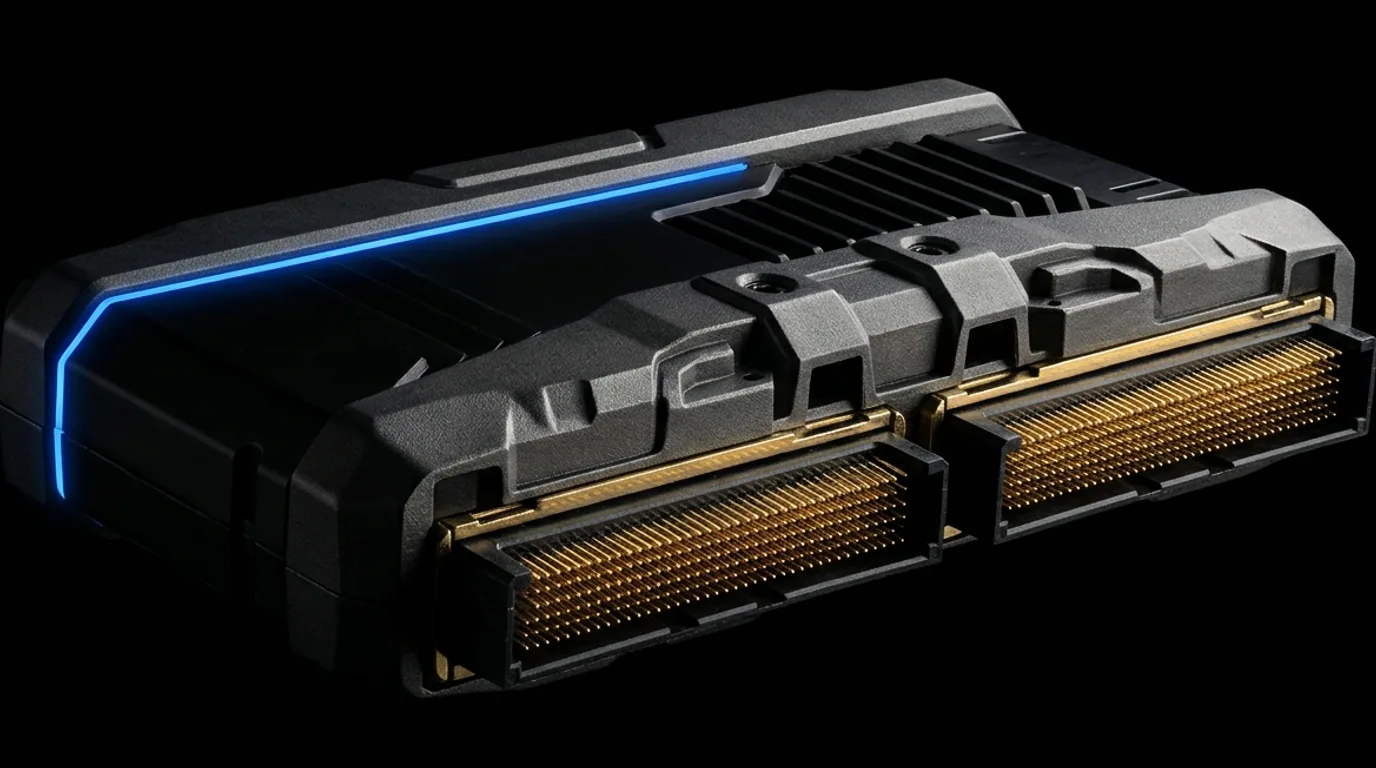
ARCHITECTURE COMPARISON
AMD MI350X is built on CDNA 4 architecture with 288 GB HBM3E memory (6.0 TB/s bandwidth) and 2.5 PFLOPS FP8 compute. NVIDIA B200 uses Blackwell architecture with 192 GB HBM3E (4.0 TB/s bandwidth) and 4.5 PFLOPS FP4 compute. The MI350X's memory advantage (+96 GB, +50%) is significant for large-model and long-context inference, while B200's compute advantage (+80% FP8 teraflops) benefits throughput-bound workloads.
The MI350X is fabricated on TSMC N5 process with 30,080 stream processors versus B200 on TSMC 4NP with 168 SM clusters. AMD's chiplet design uses 8 HBM3E stacks (12-Hi) versus NVIDIA's 8 HBM3E stacks (8-Hi). The architectural trade-off: AMD prioritizes memory capacity for inference versatility, while NVIDIA prioritizes compute density for maximum throughput on supported workloads.
INFERENCE PERFORMANCE BENCHMARKS
On Llama 4 70B FP8 inference, MI350X delivers 2,800-3,400 tok/s and B200 delivers 3,200-4,000 tok/s at batch size 32. B200's 1.4x compute advantage translates to 1.15-1.25x throughput advantage, with diminishing returns at larger batch sizes where memory bandwidth becomes the bottleneck. On context lengths above 128K tokens, MI350X's larger memory enables higher concurrent batch sizes, narrowing B200's throughput edge.
For B200 FP4 inference versus MI350X FP8, the comparison is more nuanced. B200 FP4 delivers 7,000-8,500 tok/s on Llama 4 70B at moderate batch sizes, a 2-2.5x throughput advantage versus MI350X FP8. However, FP4 accuracy degradation (0.3-1.0% on standard benchmarks) may be unacceptable for precision-sensitive applications, narrowing the effective comparison to FP8 vs FP8 where B200 holds a 1.15-1.25x edge.
VRAM AND THROUGHPUT ANALYSIS
MI350X's 288 GB HBM3E provides 50% more memory capacity than B200's 192 GB. For 70B model inference, MI350X supports batch sizes of 16-24 at FP8 with 128K context, versus B200's 8-12 at the same precision and context length. For 100B+ models, MI350X fits a full FP8 120B model without tensor parallelism, using only 120 GB of 288 GB, versus B200 requiring 2-GPU tensor parallelism for models above 150 GB.
This memory advantage translates to real-world cost savings for large-model deployments. A MI350X cluster serving Qwen 3 110B at FP8 requires 1 GPU per query with batch size 8, while B200 requires 2 GPUs per query (tensor parallelism for weights exceeding 192 GB). At equivalent pricing ($4-$6/hr for MI350X, $4-$5/hr for B200), MI350X achieves 35-55% lower per-token cost for models above 100B parameters.
SOFTWARE ECOSYSTEM MATURITY
NVIDIA's software advantage remains significant in 2026. vLLM, TensorRT-LLM, and Ollama all provide first-class B200 support with FP4 quantization, speculative decoding, and MoE expert parallelism. AMD's ROCm 6.5 provides comparable PyTorch and vLLM support for MI350X, but ecosystem breadth lags: bitsandbytes, AWQ quantization, and several inference optimization libraries lack MI350X support as of mid-2026.
The practical impact of software maturity is most visible in deployment time and optimization effort. B200 deployments using pre-built containers and automated optimization (TensorRT-LLM AutoQuantize) achieve production readiness in 1-2 weeks. MI350X deployments typically require 4-8 weeks for equivalent optimization, including ROCm stack tuning, custom kernel optimization, and HPC library configuration. Engineering time adds $20K-$50K in deployment costs.
COST PER TOKEN ANALYSIS
At standard inference pricing ($4.50/hr MI350X, $5.00/hr B200 on neoclouds), cost per token for Llama 4 70B FP8 is $0.37-$0.46 per million tokens on MI350X and $0.35-$0.44 on B200-near parity. For B200 FP4, cost drops to $0.18-$0.26 per million tokens, a 40-50% advantage over MI350X FP8, making B200 the clear cost leader when FP4 accuracy is acceptable.
For models above 100B parameters, the equation shifts. Qwen 3 110B FP8 on MI350X costs $0.65-$0.80 per million tokens (single GPU, no parallelism overhead) versus $0.95-$1.25 on B200 (requiring 2-GPU tensor parallelism). MI350X achieves a 25-45% cost advantage for large models due to its single-GPU deployment capability. For 7B-70B models, B200 maintains a 15-30% cost advantage.
DECISION FRAMEWORK AND RECOMMENDATIONS
Choose AMD MI350X when: your primary workloads are models above 100B parameters, you need long-context inference with batch sizes above 16, or you can invest 4-8 weeks in ROCm deployment optimization. MI350X's memory advantage makes it the best choice for organizations that prioritize model versatility over maximum token throughput.
Choose NVIDIA B200 when: models are 70B and below, you need FP4 throughput for maximum cost efficiency, or your team values NVIDIA's mature software ecosystem and shorter deployment timelines. B200 dominates the 70B-and-below inference market with superior throughput and cost per token. For organizations running mixed workloads, a dual-vendor strategy deploying both architectures yields 20-35% aggregate cost savings versus single-vendor deployment.